Showing posts with label Eden Rouse. Show all posts
Showing posts with label Eden Rouse. Show all posts
Thursday, July 19, 2007
Formatting
So this week I was supposed to work on analyzing the data I had gathered. I had hundreds of sequences available, but not all of the genes had enough individuals to be useful. I deleted all the genes that did not have seven or more individuals available. With less than 14 haplotypes, you can’t make very reliable conclusions about that particular gene. So it turned out that only ten out of twenty-seven genes were fit for analyzing. First, I had to transfer the sequencher files to MacClade, a program that helps you align the base pairs so that you aren’t starting in the middle of a codon. The MacClade program lets me see all the sequences in the gene at the same time. The SNPs show up very clearly because each base is a different color, so if there were no SNPs, the gene sequences would just look like pinstripes. So then I had to export the MacClade files as fasta files. I had to format all the sequences individually, which was time consuming, but now I am finally done and all I have to do is give Ralph, who has written programming to analyze selection and variation frequency for sequences. I was formerly using a program called DNAsp, which essentially does the thing that Ralph’s program does, but it would not read any of the data files I made on my computer. Also, Ralph’s program not only gives you the numbers, but also tells you how certain it is in this number. DNAsp just gives you the number. On Friday and Monday I’ll probably work on fixing my poster.

Sunday, July 15, 2007
Sequencher
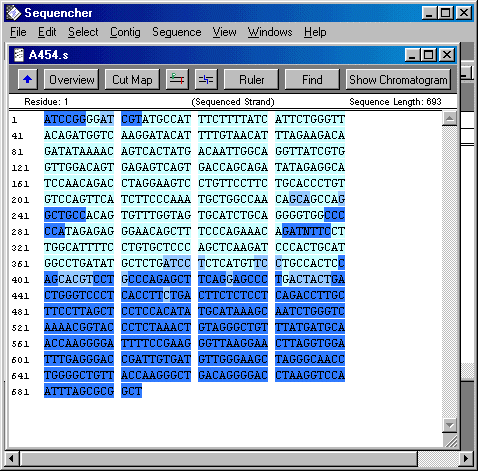
So this last week I focused on organising and cleaning up sequences in a Sequencher program. I had to find SNPs and label them by hand. Since I was reviewing 20-ish different 200 to 1000 bp sequences for 2 to 24 individuals each. THat's a lot of letters. So I didn't quite finish, but I hope to finish up on Monday. Not only did I label SNPs, I also cut off the ends of each sequence that were not reliable. Sequencher actually reads the chromatogram and translates the flourescent waves into four letters, the letters that encompass the genetic code (C, A, T, and G). Sometimes, though, Sequencher makes a bad call. When it miscalls a base or is not sure about a base, I have to fix that by changing the sequence. Once I have cleaned up all the sequences so that all sequences of the same primer pairs are the exact same length, then I will get help from some other people in the lab on analyzing the data. The picture is what the sequence looks like on sequencher. Dark blue bases mean that Sequencher is less sure about the base call, whereas light blue bases mean that Sequencher is pretty certain that the base is as it calls it.
Sunday, July 8, 2007
Sequences available!
On Monday, I got the plates I sent off to purification back from the robot on 3rd floor of the Biology building that purifies and sequences plates for the labs. When I used the spec machine to check out my DNA concentration after the purification, nearly all the tubes had a negative concentration! (not good if you want to sequence anything) Unless, of course, the DNA is simply too diluted for the spectrophotometer to read. In that case, there is hope and all is not lost. So I ran a gel on 5 ul of some PCR product comparing it to 1 ul of the stuff I had previously purified myself without using the robot. That way, even if the PCR product was really dilute, I should still be able to see a band. The wierd thing is that all of Lisa's other purifications that were purified along with my samples had no problems with the DNA concentration. At first I thought it might be our spec machine, but I checked some things I had previously purified and they were fine. It's a mystery... So the gel came back with lots of single bands-- meaning my PCR product was in there all along and could be used for sequencing. So I then prepared the plates for sequencing using Big Dye and buffer, but no water since the DNA was already so dilute. That part was easy. When the sequences came back, I got to analyze. What I did on Friday was rename all of the sequences so that their names fit which primer and individual it represents, rather than just a random number. Then I organized the sequences into primer groups. I also got a sneak peek at some SNPs, which were obvious by their characteristic double hump.... more on that next week.
Sunday, July 1, 2007
The little urchins are growing!

This week was a pretty interesting one. I'm knee-deep in my project, and the rest of the lab is working on obtaining DNA and other data from millions of baby sea urchins. On Monday I did a HUGE gel for 16 primersets and 12 individuals- that means I loaded 192 wells plus 8 ladders- all within 15 minutes. Beyond that time, the gel begins to get fuzzy and loaded DNA in one well might mix with another well. For this particular gel, I needed some high-tech equipment to fill the wells before the timer ran out. I got to use the collest pipette ever. It was just like a normal automatic pipette except that it had 8 tips instead of 1. This allowed me to load my gel much more quickly and efficiently. it's really fun to use, but hard also. Sometimes the pippette won't suck up or dispense the correct amount of liquid, which can be frustrating. So on Tuesday I got to go to the embryo sea urchin freezer where people were viewing the babies to see if they were developing on schedule. Unfortunately, some of the embryo cultures were infected with bacteria, which had to be eliminated without eliminating the babies. The first thought was to dump the sea water that the eggs were in since the eggs were on the bottom and the water was on top. But some of the eggs had already hatched and the babies were swimming around in the water. Then we used a filter to avoid the eggs and babies, but suction out the bacteria. When I got back to the lab, I looked at the big gel I had run the day before. Turns out one whole plate was ineffective, so I redid that on Wednesday. Thursday I did another gel, and Friday I got to work with the urchins again. By this stage, the urchins look like little floating, transparent pyramids that can swim. They're really cute, but sadly, they had to die for the sake of science... So I spent Friday morning centrifuging the eggs to the bottom of the tube, sucking out the sea water, and replacing it with buffer that instantly kills the larvae and preserves the DNA which is then used to understand more about the offspring. As the little babies grow, they will develop sac-like structures on their sides, from which will spring the future adult sea urchin. The interesting thing about sea urchins is that they are born twice- once from an egg, and then again from these sac-like structures. Why? Nobody knows...
Friday, June 22, 2007
PCR power

Yes, so I am still working on my project, which will involve 27 primer pairs and 12 sea urchin individuals. If you do the math, that's 324 different base pair sequences. Here's the process: PCR, gel electrophoresis, DNA purification, specs, and sequencing. For 324 different tubes. Needless to say, it will take some time, but I am almost finished PCRing all the tubes. Yesterday, I did an 8 by 12 plate of PCR reaction. Once we could get it to work, I used an automatic pipette to alloquate the primer master mixes into the 96 tubes. Surprisingly, PCR involves more math than I thought. It wasn't difficult, but I was actually forced to use a calculator. WHen I am creating the PCR master mixes, sometimes I feel like I'm cooking, putting together a recipe.. 4 ul of sugar, 25 ul of water, and 750 ul of baking soda. Delicious. But like cooking, you have to be careful about not putting in the correct amount of each ingredient. PCR is a reaction that involves a lot of different components, and depending on how many tubes you have, you master mix will be correspondingly bigger or smaller. The lab even has its own blender- the tabletop vortex that mixes up the ingredients to make everything homogenous. Of course, all this "biological cooking" hasn't changed my mind about kitchen cooking... I still avoid it at all costs, but I am learning that scientists have to be alert and focused to get specific reactions like PCR right. If you're not careful, you could spoil the batch and waste ingredients while you're at it. Overall, it's been an interesting week.
Sunday, June 17, 2007
Lots of PCRs
This first week has gone by so fast. The undergrads in my lab tell me that 7 weeks will go by like 2 days. Now I have only 5 weeks left to do my project. Although I have a vague idea about what my project will be, I don't really have a hypothesis or specific question I am answering. I am simply investigating a bunch of different genes, PCRing them, sequencing them, and then noticing any point mutations, or SNPs, that fall out of it. Since sea urchins are have a high crossing-over frequencing, and therefore have a good deal of mutations. For my project, I will be looking at 12 individuals and 27 primer sequences that will create 27 different bp sequences anywhere from 100 to 1500 bp in length. These sequences are all coding sequences in the skeletogenic network of Strongylocentrotus purpuratus, a gene network that has been heavily researched and controls the development of the sea urchin's skeleton. I am looking at each of the 27 sequences in each individual, if I have time, in order to find any interesting mutation or mutations that this particular population has in common. Since each individual has 2 copies of its genetic material, I am actually sequencing 24 x 27 sequences of DNA, and that means 12 x 27 different PCRs. To make things quicker and easier, I am doing 4 individuals with 4 primers at a time, so that I do 16 PCRs at a time.
I also learned to use the spec machine on Friday. This allows you to look at how efficient the DNA purification after PCR was. It measures the concentration of DNA vs. protein, as well as the content of DNA vs. other junk that you don't want. You pipette a tiny droplet of the mixture onto a small metal surface and the machine uses light rays to read the DNA concentration in the water.
Overall, I had a very exciting week. I have learned so much, and gotten so much experience. It was a rush of different protocols and vocabulary, and I can't wait to learn more next week and the rest of this summer!
I also learned to use the spec machine on Friday. This allows you to look at how efficient the DNA purification after PCR was. It measures the concentration of DNA vs. protein, as well as the content of DNA vs. other junk that you don't want. You pipette a tiny droplet of the mixture onto a small metal surface and the machine uses light rays to read the DNA concentration in the water.
Overall, I had a very exciting week. I have learned so much, and gotten so much experience. It was a rush of different protocols and vocabulary, and I can't wait to learn more next week and the rest of this summer!
Wednesday, June 13, 2007
Sea Urchin Gene Networks
Hi! My name is Eden Rouse and I am working in Greg Wray's lab, though he is currently on a trip to Africa. This lab's primary organism is the purple sea urchin (Strongylocentrotus purpuratus). A room near the lab houses a collection of live sea urchins from all along California's coast. Right now, the lab is working on an 8 by 8 cross with the purple sea urchin and one other species of sea urchin. They sequence the genomes of each parent, then select individual offspring to analyze. They hope to gain valuable insight into the evolutionary history of the purple sea urchin's genome as well as observe differences in populations by analyzing SNPs, which are specific point mutations in an individual's DNA. Common techniques used in the lab are gel electrophoresis, PCR, DNA purification, and gel extraction. I'm sure I will learn many more techniques as I continue working in the lab. The sea urchins are kept in artificial seawater tanks where they are fed and attended to. On my first day, I got to touch a sea urchin for the first time. I was afraid that the spines of the urchin would hurt, but I was able to hold the urchin in my hand. I also learned that sea urchins can actually move. To extract DNA from the urchin, you must pull out a spine and collect the clump of meat on the end. The lab works with the sea urchin's genome because it is a model organism and much genetic research has already been done on it, so for example, PCRs are easy to do because you already know the primer sequence to be used if you want to amplify a specific gene or bp sequence. This lab is interested in the evolutionary history of specifically the DNA of s. purpuratus as well as gene networks (these are groups of genes that work together to create a certain biological organ or limb or structure. One gene's expression affects the transcription of another.). So far this week, I have witnessed a gel electrophoresis, a gel extraction, and I started doing PCR today. It was my first time, so I learned a lot. I got to use a fancy micropipette that automatically dispences and extracts liquid, and also allows the user to dispense in repetitions. All the technology and new protocols in the lab are exciting; I can't wait to start my project.
Subscribe to:
Posts (Atom)